
Relief as unique as you
Nobody experiences Parkinson’s disease the same way — and your symptoms can change over time. Because symptoms and treatment experiences vary from person to person, determining whether DBS is right for you starts with understanding how Parkinson’s affects your daily life.
Am I a candidate for DBS?
You may be a candidate for DBS therapy if you:
- Have been diagnosed with Parkinson’s disease
- Still respond to medication, but symptom control is inconsistent
- Experience “off” time or involuntary movements (dyskinesia)
- Have symptoms that interfere with daily activities
- Are healthy enough for a surgical procedure
Because your needs are unique, your therapy should be too. The Vercise Genus DBS System is designed to work with your brain’s unique anatomy — helping you and your doctor find the right level of relief for your symptoms.²

How Parkinson’s affects the brain
Smooth, controlled movement depends on a chemical in the brain called dopamine. In Parkinson’s disease, the brain slowly loses the cells that produce this chemical. As dopamine levels drop, it becomes harder for the brain to send the right signals to your muscles.³
This change is what causes the physical movement challenges that can interfere with your daily life.
Parkinson’s symptoms DBS may help manage
DBS therapy targets the physical signs of Parkinson’s disease — giving you better control over involuntary movement challenges, such as dyskinesia. While it doesn't treat every symptom, it aims to help you manage the common ones listed below.⁴

Tremor

Stiffness and slowness

Balance and coordination

Involuntary movements
IMPORTANT INFORMATION: DBS (Deep Brain Stimulation) is used to treat only some of the motor symptoms of Parkinson's disease. The Boston Scientific DBS devices are not approved for all motor symptoms associated with Parkinson’s disease. Please refer to the Boston Scientific DBS devices’ Indication for Use statement for more information. Please discuss the risks and benefits of DBS with your doctor to see if it is right for you.
Evaluating Parkinson’s non-motor symptoms
While DBS is designed to help manage motor symptoms, your doctor also reviews your non-motor symptoms to confirm the Vercise Genus DBS System is the best choice for your unique needs.


IMPORTANT INFORMATION: DBS (Deep Brain Stimulation) is used to treat only some of the motor symptoms of Parkinson's disease. The Boston Scientific DBS devices are not approved for any of the non-motor symptoms including the ones listed above. Please refer to the Boston Scientific DBS devices’ Indication for Use statement for more information.Please discuss the risks and benefits of DBS with your doctor to see if it is right for you.
Recognizing the window of opportunity

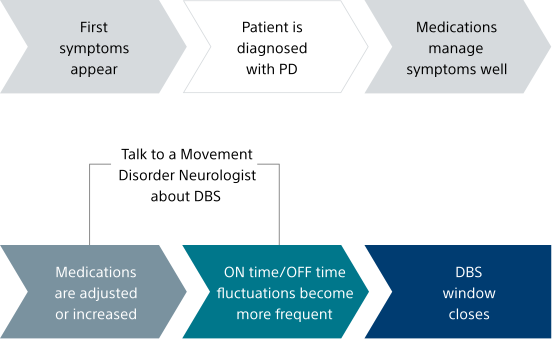
DBS therapy may be most effective during a specific window — but many people wait too long for relief. This "window of opportunity" usually opens when your Parkinson’s disease medication becomes less effective at treating your symptoms.⁵
Get started
Has a physician diagnosed you or a loved one with Parkinson’s disease (PD) or essential tremor (ET)?
You've started your assessment
Would you like to pick up where you left off?
You've completed the assessment
Based on your answers, you may be a candidate for: DBS therapy
Signs it’s time to look beyond Parkinson’s medication
As Parkinson’s disease progresses, the honeymoon phase of your medication can fade — causing symptoms to become more difficult to manage. While the Vercise Genus DBS System is designed to provide relief from these physical signs, it primarily treats movement symptoms and may not improve non-motor challenges like memory or mood changes.⁶



Deciding on DBS therapy with a specialist
While your primary care physician manages general care, a movement disorder specialist is the key to determining if DBS therapy is right for you. These neurologists have advanced training in Parkinson’s disease — guiding you through the testing and expectations needed to ensure therapy is the right fit for your symptoms.⁷

- Suzanne's DBS Story
- Ken G.'s DBS Story
- Ann's DBS Story
The patient quotes in this material describe real personal experiences. Individual results may vary. Consult with your physician to determine if you are a candidate for this procedure and what you may gain from the therapy.


Take your next step toward DBS therapy
Get started
Has a physician diagnosed you or a loved one with Parkinson’s disease (PD) or essential tremor (ET)?
You've started your assessment
Would you like to pick up where you left off?
You've completed the assessment
Based on your answers, you may be a candidate for: DBS therapy


References
- Boston Scientific Corporation. Vercise Genus™ Product Specifications. 2026.
- Boston Scientific Patient Information Brochure. Navigating Parkinson's: Your Complete Guide to Deep Brain Stimulation (DBS).
- American Parkinson Disease Association. What is Parkinson’s disease? American Parkinson Disease Association website. Accessed April 13, 2026. https://www.apdaparkinson.org/what-is-parkinsons
- Parkinson’s Foundation. Movement symptoms. Parkinson’s Foundation website. Accessed April 13, 2026. https://www.parkinson.org/Understanding-Parkinsons/Movement-Symptoms
- Schuepbach WMM, Rau J, Knudsen K, et al; EARLYSTIM Study Group. Neurostimulation for Parkinson's disease with early motor complications. N Engl J Med. 2013;368(7):610-622. doi:10.1056/NEJMoa1205158.
- Parkinson’s Foundation. Stages of Parkinson’s. Parkinson’s Foundation website. Accessed April 13, 2026. https://www.parkinson.org/Understanding-Parkinsons/What-is-Parkinsons/Stages-of-Parkinsons
- Parkinson’s Foundation. Diagnosis. Parkinson’s Foundation website. Accessed April 13, 2026. https://www.parkinson.org/Understanding-Parkinsons/Diagnosis