A healthcare professional in a white coat speaks with a patient in a bright clinical setting.

Why Boston Scientific DBS

Choosing a partner for your care is a big decision.
Our Vercise Genus™ DBS System is designed to help your physician personalize therapy from the very beginning—and continue refining it as your needs change over time.

The Boston Scientific difference

Personalized therapy begins with precision. Every person's brain anatomy is unique. That's why we believe personalization starts with placing stimulation in the right location.


Image Guided Programming (IGP) uses your own brain imaging to help your physician identify where stimulation should be delivered, providing a personalized starting point based on your anatomy. From there, your physician can continue refining therapy based on your symptoms, goals, and response over time.


Combined with our advanced directional leads, flexible programming capabilities, and proven clinical outcomes, we provide powerful tools to personalize therapy throughout your DBS journey.


Get started

Has a physician diagnosed you or a loved one with Parkinson’s disease (PD) or essential tremor (ET)?

Hardware designed for your life

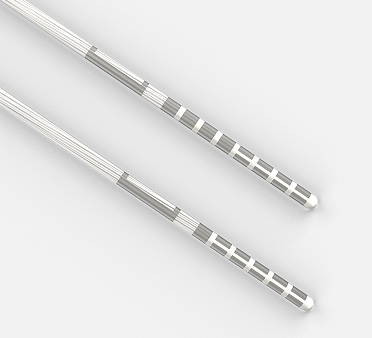
Cartesia X and HX deep brain stimulation leads.

Cartesia™ X and HX Leads

Every brain is different.


Our Cartesia™ X and HX directional leads feature 16 individual contacts, giving physicians exceptional flexibility to direct stimulation exactly where it's needed while avoiding areas that may contribute to side effects.


More contacts mean more opportunities to personalize therapy as your needs evolve.

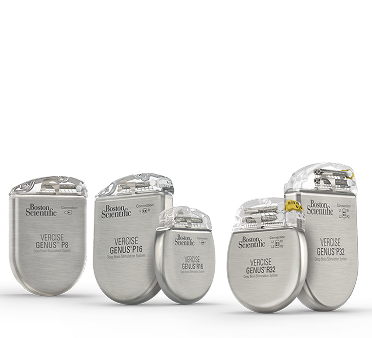
A group of Boston Scientific VERCISE GENUS implantable devices is displayed against a clean white background.

The broadest battery portfolio

Your therapy should fit your lifestyle.


We offer five battery options, including rechargeable and non-rechargeable systems, so you and your physician can choose the option that best fits your preferences and long-term treatment plan.

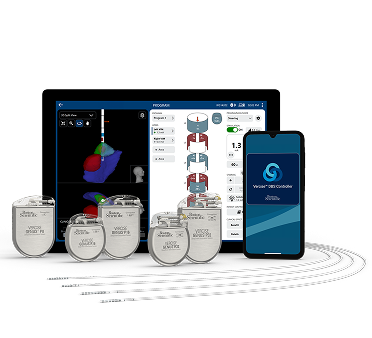
Several implantable deep brain stimulation medical devices arranged in front of a tablet and a smartphone.

Multiple Independent Current Control (MICC)

Precision goes beyond where stimulation is delivered.


MICC technology gives each contact its own independent power source, allowing your physician to adjust the size, shape, and location of stimulation with exceptional precision.


This flexibility helps personalize therapy today—and as your needs change over time.

Software that simplifies your care

Explore the intelligent software features that make your programming sessions faster, clearer, and more collaborative.
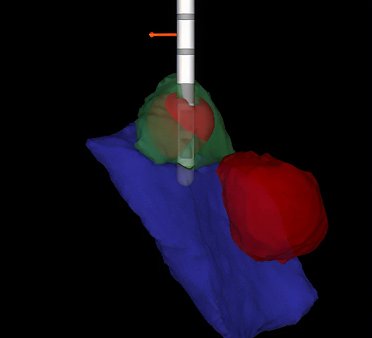
A 3D medical visualization shows several semi-transparent anatomical structures in different colors against a black background.

Image Guided Programming (IGP)

Personalization starts with your anatomy.


Instead of relying primarily on trial-and-error programming, Image Guided Programming uses your own imaging to help physicians visualize where stimulation should be delivered. They can adjust your therapy, on a screen, in real-time.1

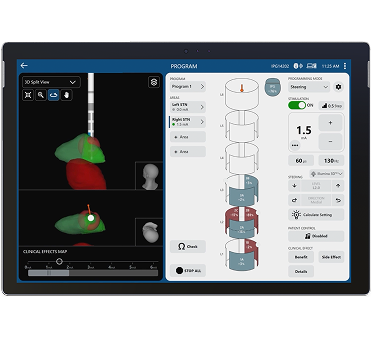
A tablet screen shows a specialized medical software interface for brain stimulation.

Precision with Illumina 3D™

Your physician can see where stimulation is going—not simply where the lead is located.


Illumina 3D software creates a specific stimulation plan using your anatomy, helping personalize therapy with confidence while making precise adjustments over time.


In one study, 88% of patients preferred the program generated with Illumina 3D compared with conventional programming.3

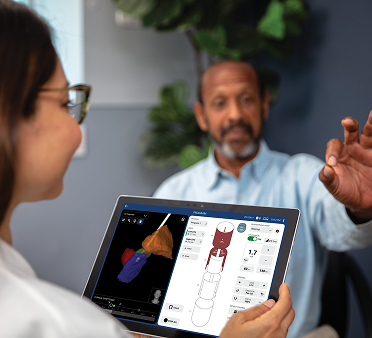
A healthcare professional holds a tablet displaying a detailed 3D medical scan and anatomical diagrams.

Efficient Programming Sessions

Less time adjusting therapy. More time focused on you.


Because Image Guided Programming provides a personalized starting point, programming sessions can be faster while still delivering precise therapy.


Real-world data demonstrated a 72% reduction in initial programming time, with stimulation settings remaining remarkably consistent over time.1

Backed by 5-year clinical data

When choosing a DBS System, you want to know it provides lasting relief. Recent studies tracking patients over 5 years demonstrate that our therapy aims to provide significant, lasting improvements for your movement disorder symptoms.2

See our technology in action

What’s Image Guided Programming?

Your anatomy provides a roadmap for personalized therapy. Learn how Image Guided Programming helps physicians visualize stimulation, personalize therapy from the beginning, and continue refining treatment as your needs evolve.

The patient quotes in this material describe real personal experiences. Individual results may vary. Consult with your physician to determine if you are a candidate for this procedure and what you may gain from the therapy.

Have questions about DBS?

Get answers to common questions about DBS, from the procedure to recovery and beyond.

Take your next step toward DBS therapy

Get started

Has a physician diagnosed you or a loved one with Parkinson’s disease (PD) or essential tremor (ET)?

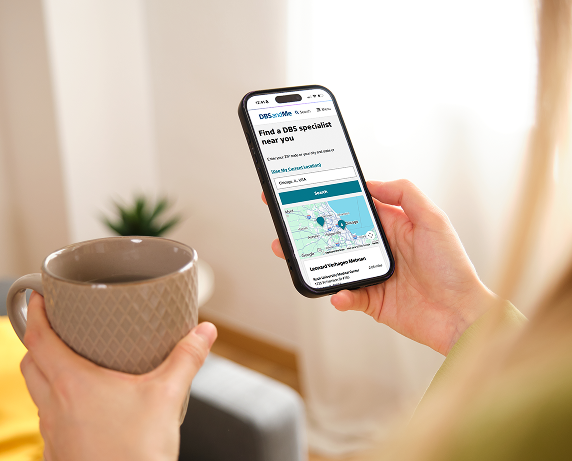
A person holds a smartphone while relaxing indoors with a mug in the other hand. The phone screen displays a website titled "Find a DBS specialist near you" with a search interface and a map.

Find Care

Locate a DBS specialist near you

Find a movement disorder specialist who offers Boston Scientific’s personalized DBS therapy near you.

A person with long wavy hair wears an over-ear headset while seated at an office workstation.

questions?

Call Patient Education

Our Patient Education Specialists can give guidance and answer any questions you have during your search for the right DBS System.

Call us at (833) 327-1473

Monday through Friday

7 a.m. to 4:30 p.m. PT

References  

  1. Aldred et al. (2023). Image-Guided Programming Tool for DBS Programming Reduces Initial DBS Programming Time and Allows for Sustained Settings Long-Term. MDS 2023 Poster. ​ 
  2. Starr PA et al. Five-Year Outcomes from Deep Brain Stimulation of the Subthalamic Nucleus for Parkinson Disease. JAMA Neurol. 2024. 
  3. M. Ferris, J. Kim, B. Reid, V. Buch. Outcomes of Algorithm Guided DBS Programming: A case series [abstract]. Mov Disord. 2025; 40 (suppl 1). https://www.mdsabstracts.org/abstract/outcomes-of-algorithm-guided-dbs-programming-a-case-series/. Accessed October 28, 2025.